Transtema
Investors
Transtema aims to provide shareholders, investors, analysts, and other interested parties with clear and timely financial information.


Corporate Governance
Corporate governance deals with how a company should be run so that the interests of its owners are safeguarded. The overall goal is to increase shareholder value and thus meet the owners’ requirements for their invested capital.
Transtema Group AB (publ.) (“Transtema”) is a public company based in Gothenburg, Sweden. The Swedish Companies Act, the Swedish Code of Corporate Governance, and the Nasdaq OMX Stockholm Rules for Issuers form the basis for the company’s governance. The company’s internal governance framework consists of the Articles of Association, the Rules of Procedure of the Board, the CEO Instructions, as well as policies and associated guidelines.
Transtema’s CEO is responsible for the company’s day-to-day management in accordance with the Board’s guidelines and instructions. In dialogue with the Chairman of the Board, the CEO also compiles the agenda for the board meetings and is responsible for preparing information and decision support for these meetings. Furthermore, the CEO is responsible for ensuring that the members of the Board receive information on Transtema’s development so they can make well-informed decisions.
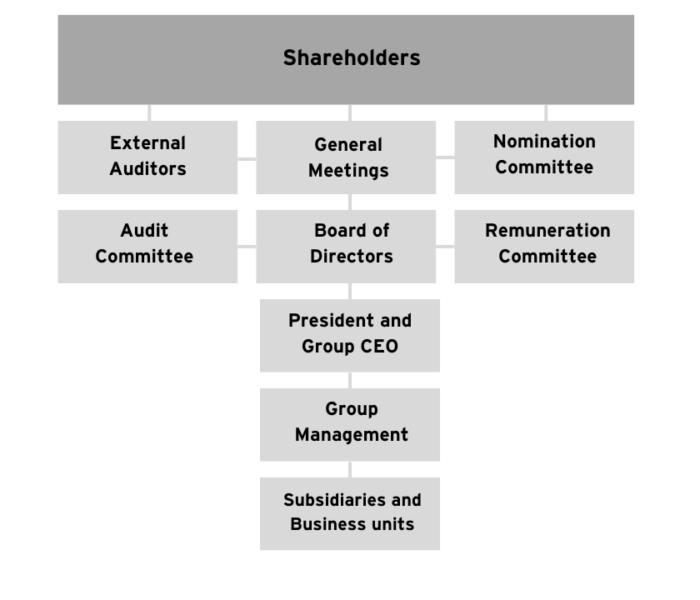
The overall aim of corporate governance is to ensure the Group’s commitments to all its stakeholders, such as shareholders, customers, suppliers, creditors, employees, and society at large. The term “Corporate Governance” usually refers to the rules and structures that are established to manage and control a public limited company in an efficient and systematic way. Transtema applies the Swedish Code of Corporate Governance.
Nomination Committee
According to the instructions for the Nomination Committee adopted at the 2021 Annual General Meeting, the Nomination Committee shall consist of four members. The members of the Nomination Committee shall be appointed by the four largest shareholders in the company based on ownership information in the register of Euroclear Sweden AB as of the last trading day in September.
If any shareholder decides not to appoint a member, the right to do so shall pass to the shareholder with the next-highest number of votes.
The Chairman of the Nomination Committee shall be the largest shareholder in terms of votes at the time of the Nomination Committee’s appointment and may not be the Chairman of the Board or another director.
If a shareholder who has appointed a member to the Nomination Committee is no longer one of the four largest shareholders of the company three months before the Annual General Meeting, such member shall resign from the Nomination Committee and be replaced by a member appointed by the shareholder who is then one of the four largest shareholders.
If a member of the Nomination Committee resigns before the Nomination Committee’s assignment is completed, the shareholder has the right to appoint a new member.
The Chairman of the Board shall convene the first meeting of the Nomination Committee.
The composition and contact details of the Nomination Committee shall be published on the company’s website no later than six months before the meeting. Changes in the composition of the Nomination Committee shall be announced immediately.
A majority of the members shall be independent of the company and its management. At least one member shall be independent of the largest shareholder or group of shareholders in terms of voting rights who cooperate in the company’s management.
No remuneration shall be paid to the members of the Nomination Committee. The company shall reimburse the reasonable expenses that the members of the Nomination Committee may incur in carrying out their tasks.
Shareholders who wish to submit proposals to the Nomination Committee may do so by e-mail:: valberedning@transtema.com.
To get in touch with the Nomination Committee, please contact:
Magnus Johansson, Chairman of the Board, magnus.johansson@transtema.com
From press release 2023-11-01
Nomination Committee appointed in Transtema Group AB (publ) for the Annual General Meeting 2023
The Nomination Committee of Transtema Group AB (publ) (“Transtema”) has been appointed under the guidelines adopted at the Annual General Meeting on 4 May 2023.
The Nomination Committee includes:
- Per Mellberg, appointed by Törnäs Invest AB (a company wholly owned by Magnus Johansson)
- Göran Nordlund, appointed by Fore C Investment Holding (a company wholly owned by Göran Nordlund)
- Jonas Nordlund, appointed by EFG Bank (a company wholly owned by Jonas Nordlund)
- Sune Tholin, appointed by himself
The Nomination Committee has appointed Per Mellberg as its Chairman.
The Nomination Committee consists of shareholder representatives accounting for approximately 44% of the votes and capital in Transtema. The Nomination Committee’s proposals will be presented in the 2023 Annual General Meeting notice and on Transtema’s website,, www.transtema.com.
The Nomination Committee’s tasks are to prepare and submit proposals for the Annual General Meeting 2024 regarding the election of the Chairman and other members of the Board, remuneration to the Board and for committee work, election and compensation of the auditor, election of Chairman of the Annual General Meeting and, where appropriate, changes to the instructions for the Nomination Committee.
The Annual General Meeting of Transtema will be held on 7 May 2024. Shareholders wishing to submit a proposal to the Nomination Committee may do so by e-mail to valberedning@transtema.com, or by letter to the address: Transtema Group AB (publ), Flöjelbergsgatan 12, 431 37 Mölndal, Sweden, no later than 31 January 2024.
Shareholders wishing to submit a matter for consideration at the 2024 Annual General Meeting shall submit such proposal to the Board by e-mail to anmalan@transtema.com or by letter to the address: Transtema Group AB (publ), Flöjelbergsgatan 12, 431 37 Mölndal, Sweden, no later than 15 March 2024 in order for the proposal to be included in the 2024 Annual General Meeting notice.
For further information, please contact:
Magnus Johansson, Chairman of the Board, magnus.johansson@transtema.com
Coprporate governance reports
Audit Committee
The Board has established a special Audit Committee. At least one director shall have accounting or auditing skills. Committee members may not be employees of Transtema. The majority of the Committee’s members shall be independent of Transtema and its management. At least one member independent of Transtema and its management shall also be independent of Transtema’s major shareholders. The Committee shall appoint one of the members to be its Chairman.
The Audit Committee consists of the following board members:
Linus Brandt (Chairman) and
Ingrid Stenmark.
The objective of the Audit Committee is to improve the quality of the Group’s accounting, external reporting, and auditing, as well as to strengthen the contact between Transtema’s Board and its auditor. In addition, the Audit Committee shall work to improve the quality and strengthen the supervision and control of Transtema’s financial risk exposure and risk management.
Remuneration Committee
The Board of Transtema Group AB (publ) has on 5 May 2022 at its inaugural meeting adopted the Rules of Procedure below for the Remuneration Committee.
The objective of the Remuneration Committee is to ensure a comprehensive, thorough, and well-founded remuneration model for the Company’s employees that contributes to the Company’s business strategy, long-term interests, and sustainability, with a focus on the remuneration for the CEO and other senior executives.
The Remuneration Committee shall, acting on instructions from the Board:
- prepare the Board’s decisions on matters relating to remuneration principles, remuneration, and other terms of employment for senior executives;
- monitor and evaluate ongoing and, during the year, completed variable remuneration programmes for senior executives;
- monitor and evaluate the application of the guidelines for remuneration to senior executives to be resolved by the Annual General Meeting and the current remuneration structures and levels in the Company; and
- prepare the Board’s report on paid and outstanding remuneration covered by the guidelines for remuneration.
The Remuneration Committee consists of the following board members:
Liselotte Hägertz Engstam (Chairwoman),
Magnus Johansson and
Anna Honnér.
The code
The Swedish Code of Corporate Governance (“the Code”) sets a higher standard for good corporate governance than the minimum requirements of the Swedish Companies Act and shall be applied by all companies whose shares are admitted to trading on a regulated market in Sweden.
The Code thus complements the Swedish Companies Act by setting higher requirements in some areas, but at the same time enables Transtema to deviate from these if it is considered that this would lead to better corporate governance in the individual case (“comply or explain”). Such deviation, as well as reasons for the deviation and alternative solution, shall be reported annually in a corporate governance report. Transtema does not expect to report any deviation from the Code in its forthcoming corporate governance report. The Code can be found in its entirety at Swedish Corporate Governance Board’s website.
Internal control
The Board’s responsibility for internal control is regulated by the Swedish Companies Act and the Annual Accounts Act, which require that information on the key elements of Transtema’s system of internal control and risk management in connection with financial reporting be included in the Corporate Governance Report each year, as well as the Code.
Internal control aims to create a clear accountability structure and an effective decision-making process. The Board has adopted a number of basic documents of importance for financial reporting to ensure an effective control environment. The Board’s Rules of Procedure and instructions for the Chief Executive Officer further ensure a clear allocation of roles and responsibilities, aiming to effectively manage the business’s risks. The Board has also established some basic guidelines and policies relevant to internal control.
The basic policy documents are subject to review on an ongoing basis. In addition, an effective control environment requires an adequate organisational structure and ongoing reviews of the same. Transtema’s Group Management regularly reports to the Board following defined routines. Furthermore, Group Management is responsible for the system of internal controls required to manage material risks in the ordinary course of business. Managers at various levels within the Group finally have defined authority and responsibility regarding internal control.
Control environment
The Board ensures that established principles for the financial reporting and internal control are adhered to and that appropriate relations with Transtema’s auditor are maintained. The Board monitors the financial reporting on an ongoing basis to ensure good internal control and continuous improvements. At least one board meeting annually focuses on internal control, risks, and management reporting. The responsibility for maintaining an effective control environment and the ongoing work with internal control over financial reporting is delegated to the CEO, who in turn delegates this to the CFO following Transtema’s Financial Policy.
The internal control structure is based on Transtema’s organisation with clear roles, responsibilities, and delegation of power. Operational decisions are made at the company level, while decisions on strategy, overall financial matters, acquisitions, and larger investments are made by Transtema’s Board with the support of Group Management. The policy documents relating to accounting, Transtema’s accounting manual, and financial reporting, the Company’s financial policy, constitute the essential elements of the control environment concerning financial reporting. These documents are updated on an ongoing basis when changes are made to, for example, accounting standards and legislation.
Risk assessment
Within Transtema, a risk assessment is carried out regularly to identify material risks relating to financial reporting. As regards financial reporting, the risk is primarily considered to lie in material misstatements in the accounts, for example, regarding the accounting and valuation of assets, liabilities, income, and expenses or other deviations. Fraud and loss through misappropriation are another risk. Risk management is built into each process, and different methods are used to assess and mitigate risks and to ensure that the risks to which Transtema is exposed are managed following established policies, instructions, and follow-up procedures, which aim to reduce potential risks and promote correct accounting, reporting, and information disclosure.
Control activities
The risks identified regarding financial reporting are managed through Transtema’s control activities, such as access controls in IT systems, attestation controls, and the like. The control structure consists of clear roles in the organisation that enable an effective distribution of responsibilities for specific control activities and aim to detect or, in time, prevent the risk of reporting errors. The continuous analysis of the financial reporting and the analysis performed at Group level are crucial to ensure that the financial reporting does not contain any material misstatements. The Group’s financial organisation plays an important role in the internal control process, which is responsible for the accuracy, completeness and timeliness of the financial reporting from each unit.
Information and communication
The Group has information and communication channels intended to promote the completeness and accuracy of its financial reporting, as set out in its information policy. Policies, guidelines, and internal instructions relating to financial reporting are available in electronic and printed form. Regular updates and announcements of changes in accounting policies, reporting requirements, or other information disclosures are made available and known to relevant employees.
Follow-up and improvement
The CEO has delegated responsibility to the CFO, who is responsible for ensuring that internal control is organised and monitored according to the guidelines established by the Board. The CFO is also responsible for conducting independent objective reviews to systematically evaluate and propose improvements to the Group’s governance, internal control, and risk management processes. Financial management and control are carried out by the group finance function. Transtema’s management performs a monthly performance review with an analysis of deviations from the budget, forecast, and previous year, and all monthly accounts are discussed with the management of the respective subsidiary or operating segment. The Board receives monthly financial reports, and the financial reporting is followed up at each board meeting. Before the publication of the Annual Report and quarterly reports, the Board and Group Management review the financial reporting. An external audit of the financial statements is carried out in connection with the annual accounts.
